
I worked the faire with my dad as a kid, and again as a young adult. Then I went off to teach, and Dad went off on his own creative adventure. Coming back to Quick Silver Mint has been a lot of fun. One of the best parts is hearing our customers’ stories. The other is hearing Dad’s.
Dad is an artist, and he designed almost everything we strike. A design usually starts with something he read or saw. He studies it, doodles it, and the doodle becomes a wax carving. A lot of his ideas come from books and photos he’s collected over the years. Some came from talking with friends, and some came from customers who asked him to make something special.
When he was showing me how to use the hammer, we brought out dies that aren’t on our website for me to practice with. It got me thinking. What other designs do we have that we haven’t shown in a while?
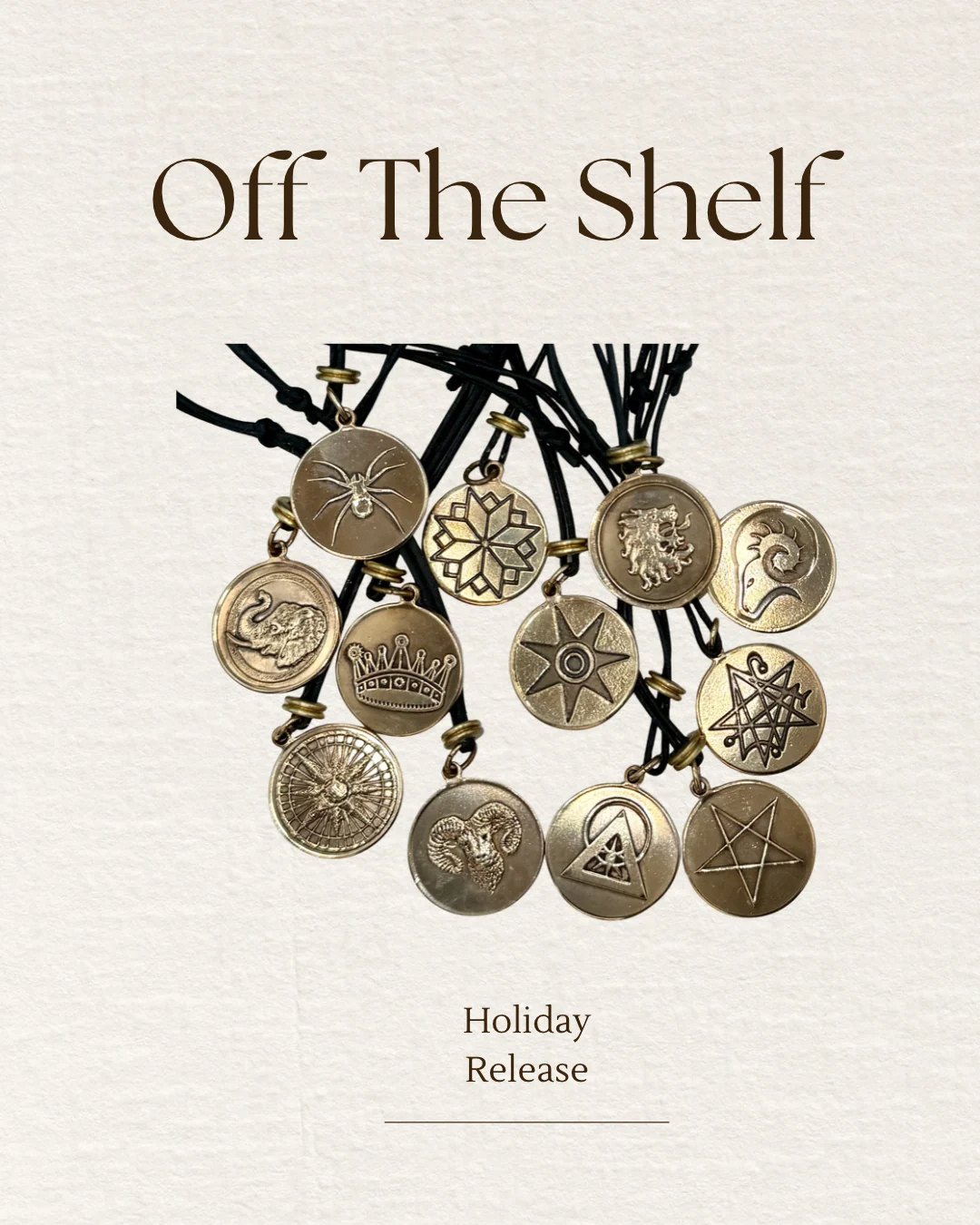
So we minted a few. Two of them, the Ram and the Elephant, are Dad classics that simply got skipped when we built our website and brochure. The rest go back years. Some Dad made at a customer’s request, some for a special event, and some purely from his own whimsy.
We’re bringing these out for the holidays to see what you think. Let us know which ones you like. And if you already have one, we’d love to hear where you got it. The ones you like best might end up on the website for good.
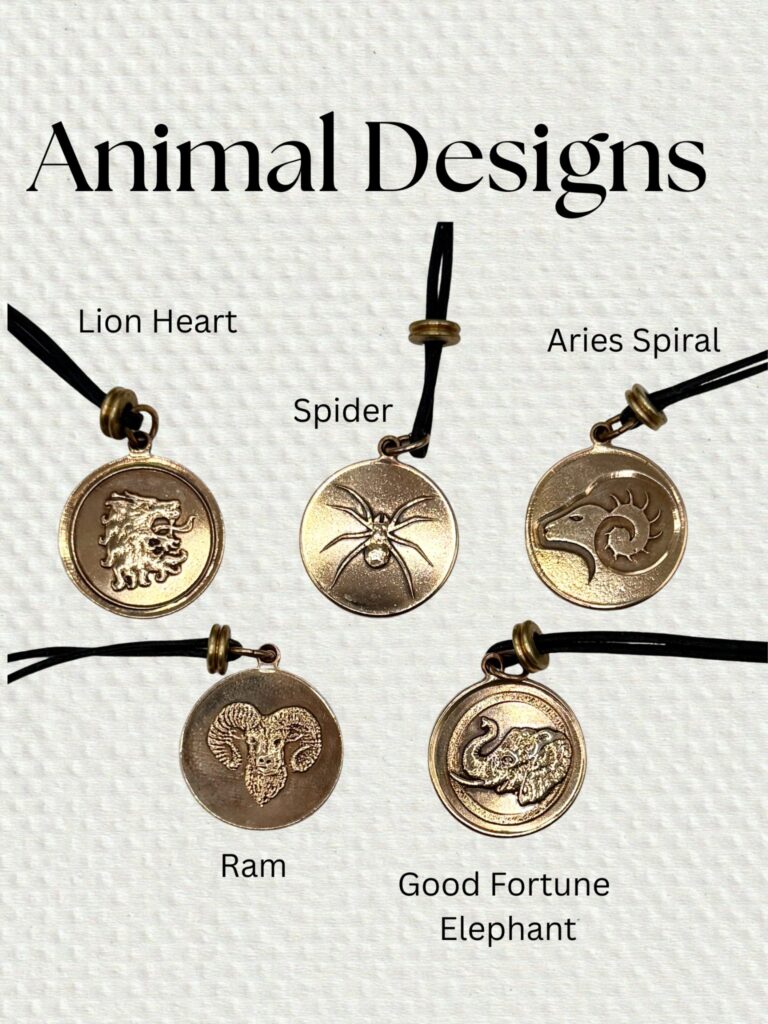
Good Fortune Elephant
The story. This is a Dad classic. It never went anywhere; it just got left off when we built the website and brochure. I’ve seen his original wax carving, and I think it’s the Elephant’s turn.
The history. Elephants mean good luck in many places, including India, Thailand, China, and Cambodia. They’re also tied to wisdom and memory. In Hindu stories, the god Indra rides a white elephant named Airavata. People even disagree about the trunk. In the West, a trunk pointing up is supposed to mean your luck won’t run out, and in parts of Asia, a trunk pointing down means you’re holding on to it.
Today. It’s still one of the most popular good luck charms around. I think it’s a good gift for someone starting over, whether that’s a new job, a new house, or just a new year. Elephants look after their families, so it works for family people too.
Lion Heart
The story. Dad thinks he may have made this one for an event. If that rings a bell, please tell us.
The history. No animal shows up in heraldry more than the lion. For hundreds of years, it’s meant courage and royalty. Knights and noble families put lions on their shields so everyone knew who they were. Richard the Lionheart had them on his. In medieval church art, a lion could also mean Saint Mark or the resurrection.
Today. England and Scotland still have lions on their royal arms. This is a good one for someone who could use some courage this year, anyone with family roots in old European heraldry, or a Leo.
Ram
The story. Another Dad classic that got left off the website and brochure. I have the original wax, and it’s one of my favorites.
The history. In ancient Egypt, the god Amun was often shown as a ram, and the creator god Khnum had a ram’s head. In the Greek myth, a ram with golden wool flew two kids away from danger. Its fleece is the Golden Fleece that Jason and the Argonauts went looking for, and the ram ended up in the sky as Aries.
Today. Aries starts the zodiac in spring, so the ram goes with fresh starts and pushing ahead. This is one of the boldest strikes in the group. It’d be a good pick for an Aries birthday or someone starting something new.
Aries Spiral
The story. Dad made this for something years ago. That’s all he’s told me, so maybe you know more than I do.
The history. Spirals are about as old as art gets. They’re carved into the stones at Newgrange in Ireland, which is older than the pyramids, and you’ll find them on pottery and weaving all over the world. They usually mean growth or cycles, a path that goes out and comes back around like the seasons. Horns have also long stood for plenty.
Today. The curl of a ram’s horn is where the Aries symbol comes from. Dad kept this one simple, just a long face and one big curling horn. It has an almost modern look and is easy to wear every day.
Spider
The story. I think Dad was just playing with this one. When it came back from the die maker, it didn’t have quite the detail he wanted, so it went on the shelf. Honestly, I think it came out great, and two people have already asked me for one.
The history. Many old stories treat spiders as weavers or storytellers—the Navajo tell of Spider Woman, who taught people to weave. In West Africa, there’s Anansi, a trickster spider who wins all the world’s stories from the sky god. My favorite is the Greek story of Arachne, who was such a good weaver that she challenged Athena and was turned into a spider.
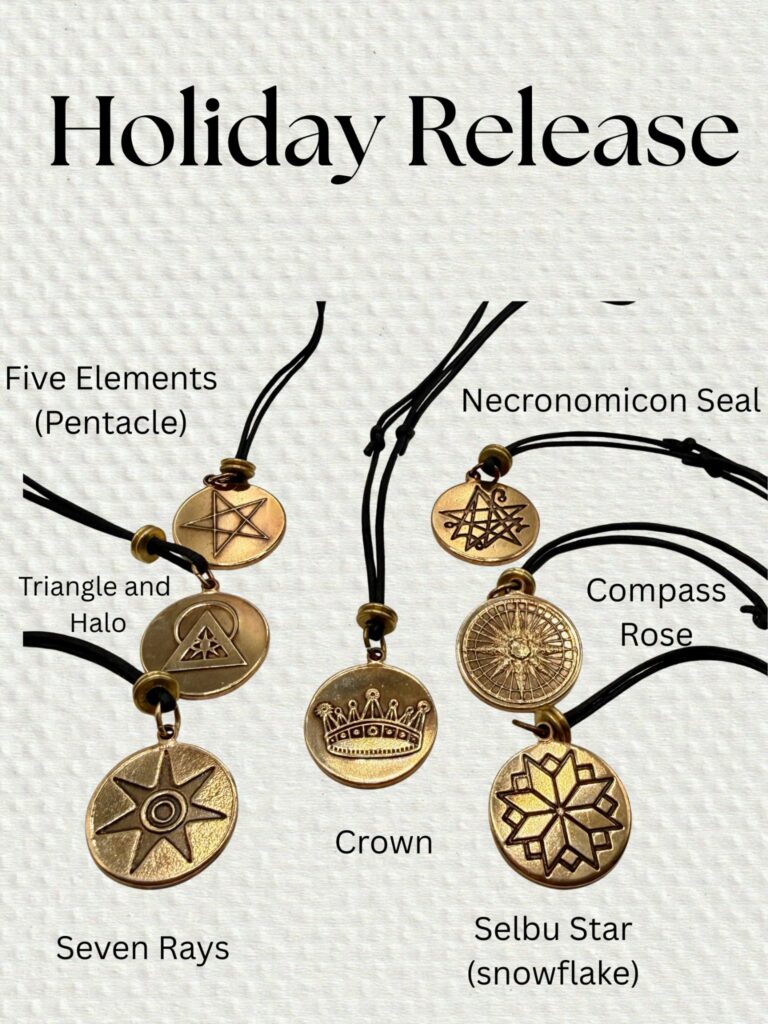
Five Elements (Pentacle)
The story. This one belongs with Dad’s alchemy designs. He’s always liked the old alchemy symbols, and the pentacle fits right in.
The history. The five-pointed star is really old. It shows up on Sumerian pottery from Ur dated to around 3500 BCE, and at different times it was linked to the gods Ishtar and Marduk. Put a circle around it, and you have a pentacle. Medieval Christians connected the five points to the five wounds of Christ. Other people read them as earth, air, fire, water, and spirit, with the circle holding them together.
Today. Most people now know the pentacle as a Wiccan and pagan symbol of protection and balance. It’s even on the approved list for headstones in U.S. government cemeteries.
Triangle and Halo
The story. Honestly, I don’t think this one is done yet. I have some ideas for it and wanted to show you before I go further. Tell me what you see.
The history. A triangle has three sides, and people have hung all kinds of meaning on that, like mind, body, and spirit. In alchemy, an upward-pointing triangle means fire. A circle has no beginning or end, so it usually means wholeness. Old books of ceremonial magic used circles and triangles together for protection, and Renaissance artists used them to work out proportions.
Today. You see triangles and circles a lot in sacred geometry jewelry. Usually the idea is a person held inside something bigger. On ours, the circle sits around the triangle like a halo, with a small sigil in the middle.
Seven Rays
The story. Dad made this one years ago. When I asked him about it, he just said it was popular. So we’re bringing it back.
The history. Before telescopes, people could see seven lights moving across the sky: the Sun, the Moon, Mercury, Venus, Mars, Jupiter, and Saturn. Alchemists paired each one with a metal. Christians used the seven-pointed star for the seven days of creation and also to keep evil away. The Cherokee use one for their seven clans.
Today. Wiccans and pagans call it the Faery Star or Elven Star. If you live in California, you’ve probably seen one on a sheriff’s badge or the Highway Patrol seal. Dad put rings in the center of ours, so it looks like a sun. I like it for the winter solstice, when the days finally start getting longer.
Necronomicon Seal
The story. Dad made this one because he loves the patterns in it, and he’s studied these kinds of symbols for years. He carved it in wax one line at a time.
The history. The Necronomicon started as made up. H.P. Lovecraft invented it in the 1920s for his horror stories, and he never said it was real. Then, in 1977, a book came out with the same title, edited by someone who went by only “Simon.” It mixes old Mesopotamian myths with Western ceremonial magic. Historians agree it’s a modern book, not an ancient one.
Today. This seal is one of the best-known images from that book. It’s not a devil-worship symbol, and it isn’t tied to any one religion. Most people who wear it are Lovecraft readers, horror fans, metal fans who know it from album covers, or people into occult history.
Selbu Star (my kids call it the Snowflake)
The story. Dad first made this one for the back of another piece. I think it holds up fine on the front.
The history. Most people see a snowflake. In Norway, it’s a rose, the selburose, named after the town of Selbu. In 1857, a young woman there, Marit Guldsetbrua Emstad, knitted three pairs of mittens with an eight-petal rose on them and wore them to church. Before long, Selbu women were knitting star mittens by the thousands, and a lot of them earned their own money doing it. During World War II, the mittens became a quiet sign of Norwegian resistance. The star itself is much older than any of that. In Northern Europe, it used to be a sun symbol.
Today. Norwegians who moved abroad brought the star with them, and now you see it everywhere around Christmas. Some Norwegian knitters call one version the ram’s horn rose, which I like, since we have two rams in this group.
Crown
The story. It’s just a crown. But when I see one, I think about the queens who wore them, and mostly I think about Grace O’Malley. She was the Irish pirate queen who sailed to London to meet Elizabeth I, and the story is that she wouldn’t bow. That felt right for our new pirate. I wish I’d thought of it when I struck our very first one. I didn’t, and I still keep that first pirate just for me.
That’s where the crown on the back came from. Sometimes I think more about the side against my chest than the side I show. That’s part of the fun for me. It’s like wearing a secret, or a seal that’s just mine.
The history. Grace O’Malley was a real Irish chieftain who ran ships off the west coast of Ireland in the 1500s. In 1593, the English governor took her sons, so she sailed to England to ask the queen herself. They met at Greenwich that September. The legend is that Grace wouldn’t bow because she didn’t see Elizabeth as Queen of Ireland, and that she had a dagger on her the whole time. True or not, she got what she came for. Elizabeth ordered her sons let go.
Today. The Crown goes on the back of our new pirate. Wear the pirate out and keep the crown to yourself, or flip it and let your crown show.
Compass Rose
The story. The compass rose is such an iconic design. Dad thinks someone may have asked him for this one.
The history. Compass roses started showing up on sailing charts in the 1300s. The points were first named after the winds, and later mapmakers marked north with a fleur-de-lis. Sailors steered by them for hundreds of years.
Today. People like it for graduations and big moves.
Want one?
Order an Off the Shelf medallion and pick your design and your metal. If you want it under the tree, please order by Dec. 11. The mail has been slow this year, and we’d rather you have it in time.
As always, I’d love to hear from you. Tell me which ones you like.