
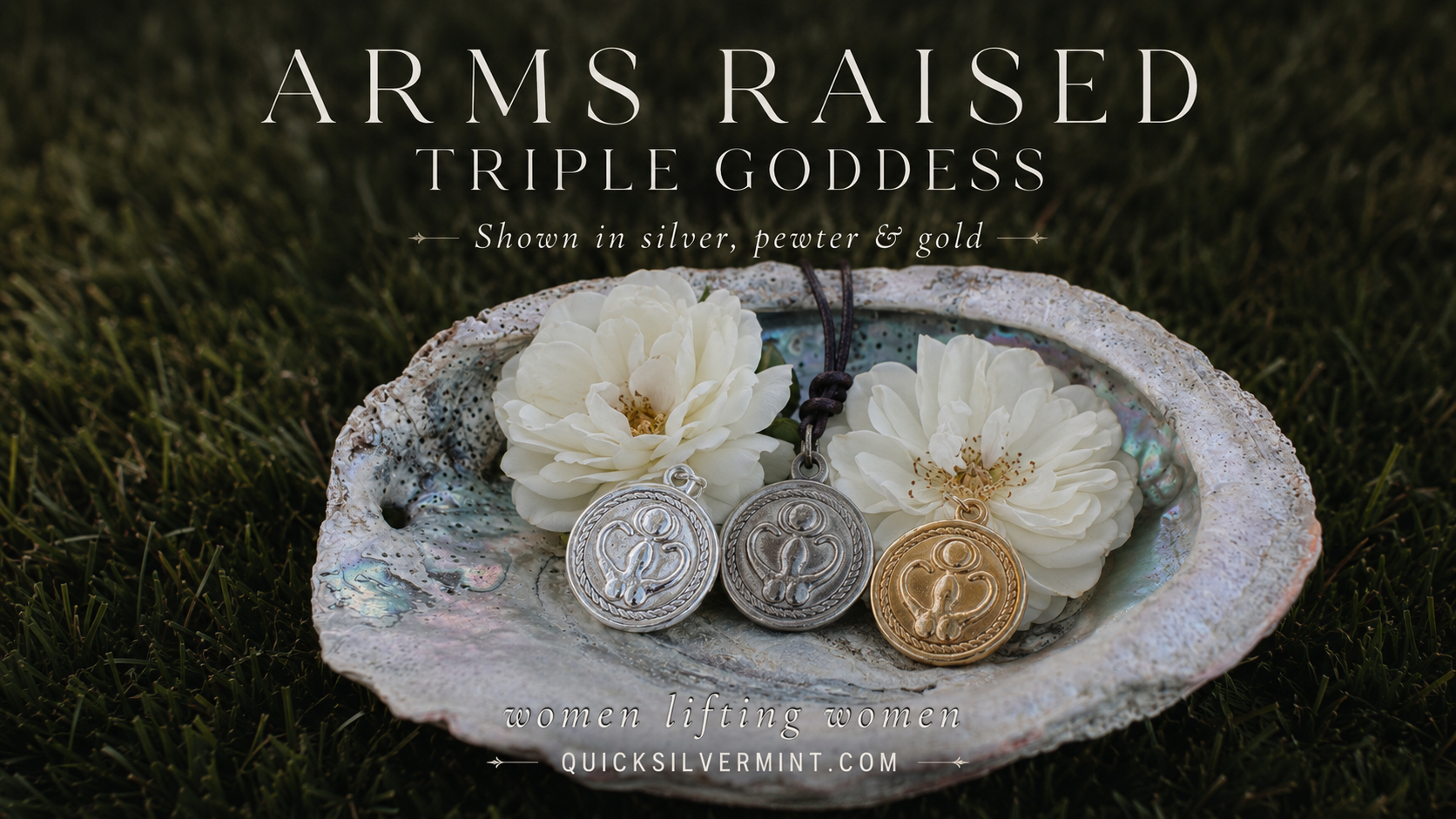
Arms Raised
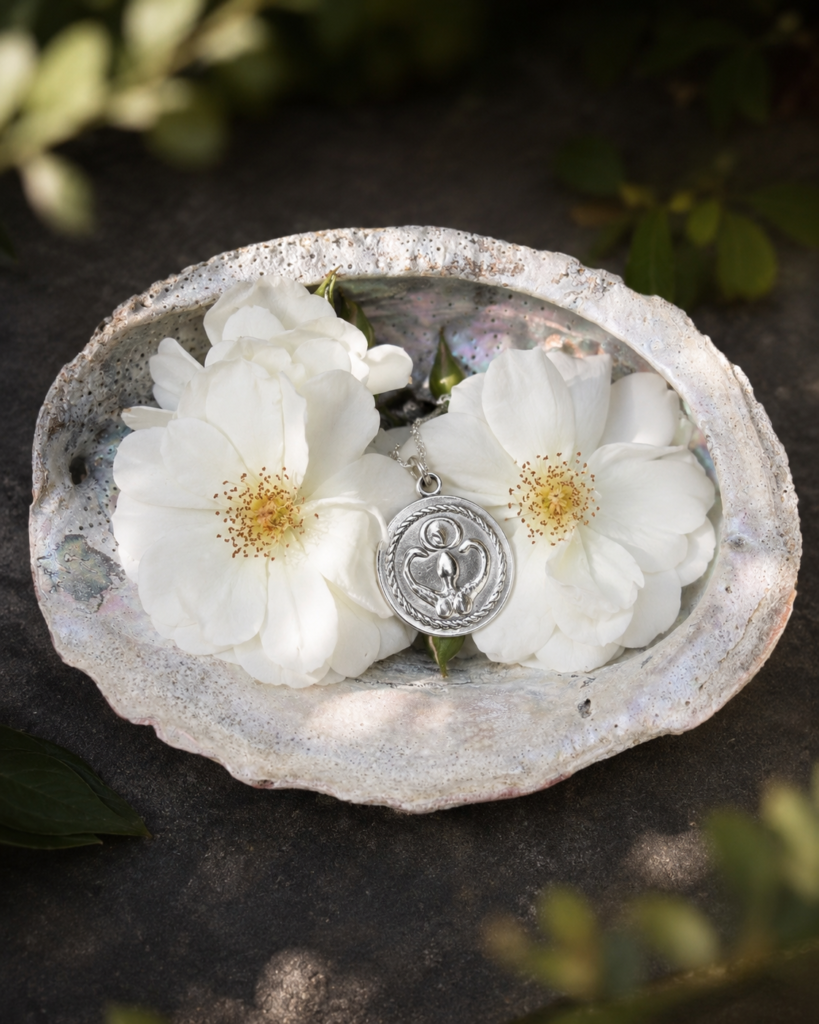
The medallion shows a woman beneath a triple moon, her arms lifted around it. I did not place those symbols there. My dad made this piece long before we had words for what they might mean.
Now I see the Triple Goddess in it: maiden, mother, and crone. The young woman becoming. The mother holding. The older woman carrying the wisdom of everything she has survived.
But I no longer see them as three separate women.
I see women at every stage raising their arms for one another.
Women at Every Stage
I think about the young women coming behind us. They are brilliant, capable, and often leading the way, but they still need our wisdom and our care. They need us to shine a light so we can truly see them. Not just to warn or correct them, and not to measure ourselves against them.
We need them too.
I have learned wisdom from eight-year-old girls and twenty-year-old women. I have learned from women who guided me when I was twenty, and from mothers who mothered alongside me, never above me.
I have been held by deeply Christian women who prayed with me in dark times. I have been shown kindness and dignity by queer women who stood as beacons when I needed light.
Queer to Christian. Queer and Christian.
The raised arms reach past labels. They ask us to look higher and choose compassion, courage, and the willingness to lift one another.
The Woman and the Moon
The Maiden, Mother, and Crone are connected to Wiccan, Neopagan, and feminist spirituality. They represent stages of life, commonly linked to the waxing, full, and waning moon.
Triple female deities and groups of three goddesses appear across ancient traditions. But the specific idea of one Triple Goddess divided into Maiden, Mother, and Crone is a modern interpretation, developed and popularized through twentieth-century writing, especially the work of poet and mythographer Robert Graves. It has become influential within modern Pagan traditions. Historian Ronald Hutton examines this development in The Triumph of the Moon.
The moon makes sense as their shared symbol because it changes without becoming less whole.
The crescent does not apologize for not being full.
The full moon does not remain full forever.
The waning moon is not disappearing. It is moving toward another beginning.
That may be the deeper meaning of the three figures. None is the final or most valuable version of a woman.
The maiden is not just waiting to become a mother.
The mother is not valuable only because she gives.
The crone is not a woman whose important years are behind her.
Each carries something the others need.
And “mother” does not have to describe only the woman who gives birth. It can describe the one who makes space, protects a dream, feeds a friendship, organizes a playdate, calls to check in, teaches, listens, forgives, or stands beside another woman while she finds her footing.
The Mothers We Rarely Reward
There are not many trophies for mothering.
No award for the afternoon you stopped trying to accomplish anything and just played.
No medal for reaching toward a sister when it would have been easier to compete with her.
No recognition for noticing another mother was barely holding it together and choosing kindness instead of judgment.
No ovation for admitting you were done.
Certainly no trophy for losing your composure, calling your child a name, feeling terrible about it, apologizing, and beginning again.
Yet those moments may matter more than the polished ones.
Seven in the Morning
Years ago, I found myself at Walmart at seven in the morning with my children still in their pajamas. They were thrilled to be getting a sticky breakfast. I was trying to find a teacher gift, classroom craft supplies, something for dinner, and somehow still get to work on time.
I must have looked like a disaster.
That morning, I made an oath to myself: never judge another mother.
I did not know what she had already carried before I saw her. I did not know what her morning required, what her child needed, what she had forgotten, what she had survived, or how hard she was trying to hold everything together.
Later, when I went through chemotherapy, I saw the mother network more clearly than ever.
A neighbor who barely knew me organized playdates. Girlfriends spent their actual vacation time showing up during cancer. Women prayed, fed people, drove children, filled gaps, and lifted their arms around my family.
Cancer took many things. One of its strange gifts was showing me the network that had been there all along.
A New Phase
I think I am entering a new phase now.
Not maiden, mother, or crone as a fixed category, but a phase where I want to stop competing and raise other women instead.
The world teaches women to watch one another carefully.
Who looks younger?
Who is succeeding?
Whose children are thriving?
Who is beautiful, admired, productive, needed, or chosen?
The moon offers another way.
It does not compete with its earlier or later self. It does not resent the crescent for arriving, or the waning moon for knowing something it has not yet learned. Each phase belongs to the same light.
Maybe our work is to look at women that way. To honor each one in the stage she inhabits and the way she chooses to present herself. To recognize the maiden inside the older woman, the wisdom already forming inside the girl, and the mothering heart that may appear at any age, in any faith, in any identity.
My question now is not simply, who has raised her arms for me?
It is also: where can I raise mine?
Who can I encourage instead of measure myself against?
Who is doing invisible work that deserves to be seen?
Who can I tell, and sincerely say, “I see you”?
That is what this piece means to me now.
Not one goddess standing alone below the moon, but generations of women lifting their arms toward one another.
Not competing for the light.
Helping each other shine.
Further Reading
For readers interested in the history behind the modern Triple Goddess, I drew from the following work: